Liquid silicone for mold making
Silicone for creating custom molds that can be used not only for resin but also for other casting materials. It is very well draped and reproduces every single detail.
Its special composition and resulting hardness of 20 Shore A guarantee optimal results for a wide range of applications. This makes it the ideal silicone for those who always want an excellent result in a wide variety of projects. From small reproductions of jewellery and smaller decorations to large sculptures.
The production procedure and calculation of silicone consumption can be found here.
The finished moulds are suitable for casting resin, concrete and other cold cast materials as well as wax and soap. On the other hand, they are not suitable for metals such as tin, lead, etc.
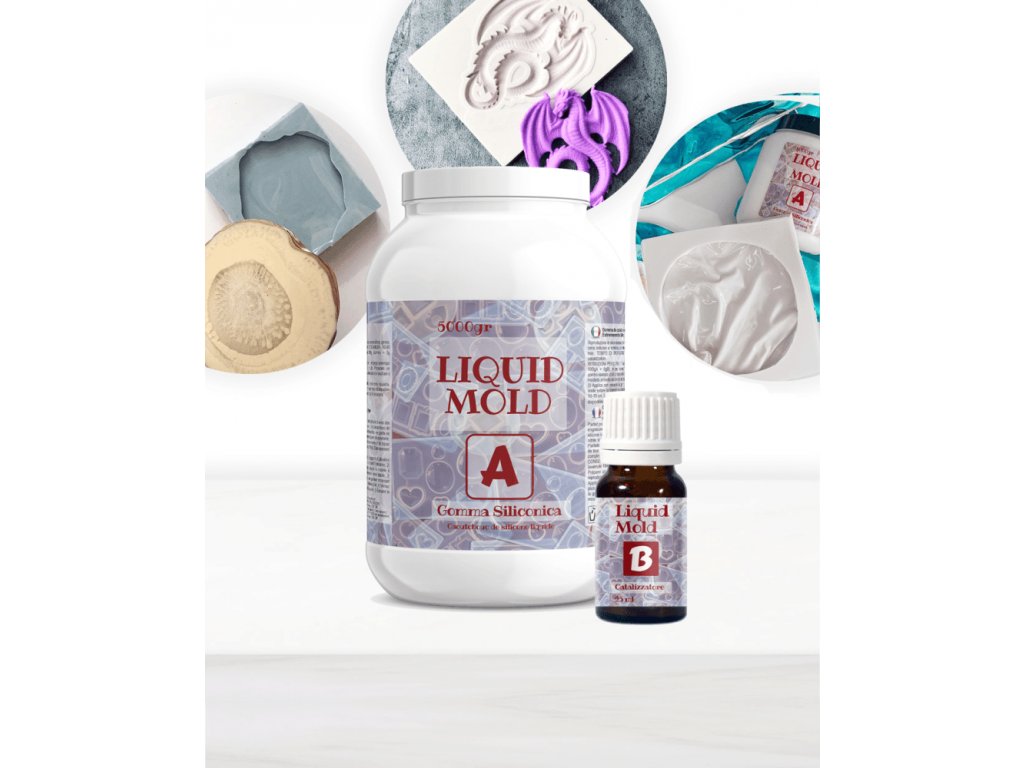




Thanks to the special texture, the moulds do not deform and at the same time ensure easy removal of the model. If the model is made of porous material or silicone, treat it first with a separator to prevent the silicone from sticking to it. Liquid silicone for mold making is designed to capture even fine details, sharp edges, or textured surfaces without issues.
Why choose this silicone for mould making?
-
Optimum hardness of cured silicone (20 Shore A) for a wide variety of applications.
-
It is compatible with resins, waxes, plaster, soap or polymer paste.
-
It's durable. When used correctly, the mould produced will last up to 50 perfect castings.
-
This silicone for molds has a long pot life to ensure maximum mold accuracy.
Technical properties of silicone for molds:
-
Mixing ratio 100:2 by weight.
-
Working time is 50-60 minutes at ambient temperature and material temperature of 20 °C.
-
Complete cure in 12 hours at an ambient temperature of 20 °C.
-
Hardness 20 Shore A.
-
Colour white, semi-gloss.
-
Viscosity: 10000 (MPa.s).
-
Tensile strength >= 4,3 MPa.
-
Elongation at break >= 390 %.
-
Breaking strength, KN/m >= 27.
How are silicone molds made?
The production of silicone molds for casting begins with preparing the model and the casting container, into which the original is placed. The silicone is then mixed and poured slowly to best fill all details and avoid bubbles. After curing, the mold is carefully separated from the model and can be used for repeated casting of resins, waxes, soaps, or other materials.
List of ratings
 Milan Paul
 Jaroslav Zelený
 Miroslav Vrba
Be the first who will post an article to this item!